Direct Link:
https://www.captechu.edu/blog/ground-systems-engineering-for-astronautical-bachelors-students
www.CapTechU.edu
Flight Ops Engineer:
Ground Station, we are ready for acquisition of signal.
Ground Station:
Copy! We see the bird and a sweep is under way.
Flight Ops Engineer:
Roger!
Ground station:
The sweep is complete. You are go for command!
Flight OPS Engineer:
Copy! We have acquisition of data. We’re
receiving telemetry, Wait! What is that? Two reaction wheels just failed
and the spacecraft has started to tumble. The spacecraft has initiated
an RTS for entry to safe-mode. Start the investigation and prepare a
recovery procedure.
As an
astronautical engineering bachelor’s student
at Capitol Technology University, this could be a scenario you
encounter when you command and control a simulated satellite in real
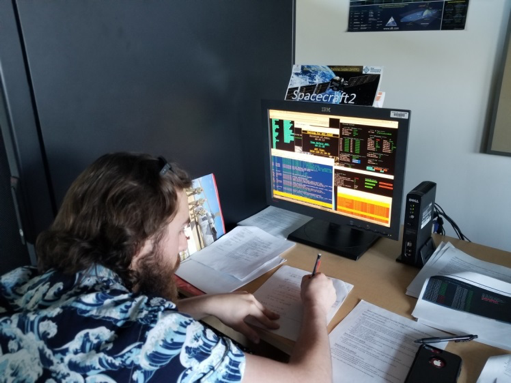
time in Capitol’s
Space Flight Operations Training Center (SFOTC).
Made possible by technology developed and donated to Capitol Technology University by the
Hammers Company,
the SFOTC is a mission control center-like environment equipped with a
spacecraft ground system (known as the Galaxy Telemetry and Commanding
System) that is used on various NASA and commercial missions. It also
houses spacecraft simulators, a spacecraft station contact clock, and
software for orbit determination and analysis. Together, these resources
enable students to experience what it’s really like to run a mission.
Unique to Capitol’s program, working and learning in the SFOTC is a
part of the required coursework for all astronautical engineering
majors, so no student misses the opportunity to experience applying
their education to the center’s real-life inspired scenarios.
Although there are plans to expand the offered courses in the SFOTC,
bachelor’s students can currently take up to a total of four courses
being taught in the center: AE-150 Introduction Into Space, AE-250
Ground Systems Engineering, AE-350 Autonomous Ground Systems (or as
students call it "advance spacecraft operations training") and AE-454
Spacecraft Dynamics and Control.
Professor Marcel Mabson and Professor Rishabh Maharaja, who founded
the center along with Professor and Astronautical Engineering Chair
Angela Walters, are excited about the opportunities available to
students through the center. “Capitol has a unique program with the
SFOTC,” says Mabson. “There aren’t a whole lot of schools that have
this. Unless you have a real control center with a real spacecraft
mission, your students are just reading out of books. And you can teach
it out of a book, but you don’t really see it and you don’t experience
it.”
“By the time you become a senior student, you not only have a
subsystems level of experience, but you also have operations and anomaly
related experience,” adds Maharaja. “It’s like a flight school. From
day 1 you have to understand what happens when anything goes wrong as
well as all of the systems in that aircraft. Satellites are very similar
to that when it comes to operations.”
Wanting to know more about just what we could learn in the Space
Flight Operations Training Center, we asked the professors to tell us
about one of the classes they teach, AE 250: Ground Systems Engineering.
Professor Maharaja explains, “The class has four major learning
goals: Real time command and control, mission planning, flight dynamics,
and telemetry trending analysis. AE 250 provides a good overview of
ground systems that are within what is called a mission operations
center or a MOC. The MOC is analogous to what we have at the SFOTC in
the McGowan building, but it also extends into a little bit of the
ground systems side of things, like the antenna centers that actually
receive a lot of this satellite data. We’re talking about what is going
on in the space network as well as the ground network side of the
various different segments.”
Students can expect to learn how telemetry, or data, comes down to a
satellite, how to read and interpret that data to predict what the
satellite will do, and how to send commands to the satellite. “AE 250
provides a great intro to the situational awareness of various different
satellite systems,” says Maharaja.
“There’s the mission planning aspect,” he continues, “where we are
able to show students how to, in a very generic way, build these mission
sequences and upload them to the spacecraft. And then viewing the
telemetry to make sure that you know your spacecraft did that action.”
These mission sequences are like instructions that you send to the
satellite. Professor Maharaja encourages students to, “think of a
satellite as a big fancy robot that we threw up in space. So it’s no
different from a Roomba, it’s just a lot more complex. A Roomba has to
be told which room to go to and where to vacuum clean, similarly a
satellite has a set of mission sequences that it needs to do something.”
“For the 250 final they actually do what we call a week in the life”
says Mabson. “Rishabh and I present the students with a schedule we call
passes. - Passes is when the satellite is in view of a ground station. -
For 7 days we say here’s a contact for all your spacecrafts and each
team - teams of 2 - has to schedule when they are going to be on
console, and they have to upload the commands, download data, and make
sure everything is okay. So they are getting those hours.”
It’s a class built around inspiring confidence in our students. The
professors explain that many of the students who come into 250 have
never done anything like this before and are often nervous to command a
satellite.
“Think of AE 150 as getting your feet wet, and one thing I like about
250 is that initially you bombard them with a lot of theory, and then
when students start doing the live it’s almost like pushing them into
the water. Lightbulbs start going off – oh I remember this from class!
So initially there’s a bombardment of information and then when they get
into the lab it’s like OH!” says Maharaja.
“My favorite thing is the end of the semester,” adds Mabson. “They’re
at their final week, they are doing their day in the life and it all
starts to click in their minds. Oh, this is what telemetry looks like,
oh I understand how to transmit a command to the spacecraft, oh the
spacecraft did A, B, C, D, oh I can check on my checklist. To see them
all start to work together and have it all become familiar and second
nature. The whole point of this is that they can get on a console and
it’s second nature and they know what they’re doing.”
Capitol alumni working in the field are encouraged to reach out to
the SFOTC. If you have any great anomaly experience that you would like
to share with us, our professors love using your content to build
scenarios for Capitol classes. To reach out to us, please email
SFOTC@captechu.edu.
Interested in learning more? Additional information about the center can be found
here.