 The
SFOTC employs Hammers-designed VirtualSat® dynamic simulator and
Galaxy® telemetry and command software to provide students with the
opportunity to control and command virtual satellites, replicating
scenarios they will encounter in real-time as professional space flight
engineers.
“Today we’re launching the next generation of space operations activities for Capitol,” said the university’s president, Dr. Michael Wood. “The SFOTC is going to take what we have developed so far and expand it into an opportunity to train and educate students in the details of space flight operations.”
“It’s going to open the doors to more jobs and careers for our students both in the NASA community and in the government and private sector community,” he said.
Steve Hammers, CEO of The Hammers Company, said Capitol students now have access to a unique resource, one which will provide them with a competitive edge compared to graduates from any other university or college offering degrees in the field.
 “Professors can actually inject problems into the systems, test the
students and get their reactions,” Hammers said. “Students can develop
on their own procedures to rectify and correct the spacecraft, to make
them safe. When they get into the real world and they see the real
telemetry coming back from the satellite it will be no different than
what you see on the SFOTC displays. It’s the actual flight code. It’s
the actual ground system and dynamics that you see in orbit today.”
“We’re not aware of any other capability that exists like this anywhere in the world,” Hammers said.
The new center builds on an existing track record of hands-on space flight operations training at Capitol. As part of a ten-year grant provided by NASA, Capitol hosted a backup mission control center for NASA on the university campus in what was then known as the Space Operations Institute (SOI).
Several Capitol alumni who participated in the SOI were on hand to mark the launch of its successor, the SFOTC.
“It’s the next step,” says 2009 graduate Ben Holt, who has since served as lead engineer for multiple NASA satellite missions, including the EO-1 and Advanced Composition Explorer (ACE) satellites. “In the SOI we took a satellite that was already flying, mimicked what the ground station was doing, and made a backup ground station for it, so we got some flight experience. In the SFOTC, however, students can actually see what happens if you throw an error into it.”
That represents an enhancement over training with live satellites, Holt noted, because students can be exposed to a wider range of possible problems.
“Students will be able to simulate anomalies and figure out how to fix them, and so they’ll be much better prepared for the future,” Holt said.
With its inauguration, the SFOTC joins a growing array of laboratories and other resources designed to provide students with practical experience in applying the education they receive in the classroom. These include the Fusion Lab, which brings together astronautical engineering and cybersecurity students for collaborative projects, and the Cyber Battle Lab, which provides a venue for practicing cybersecurity skills in real time.
Capitol Technology University is Maryland’s only independent institution of higher learning with a focus on engineering, computer science, information technology and business, offering programs at the undergraduate, master’s and doctoral levels. It is a Department of Homeland Security and National Security Agency-designated Center of Excellence in cybersecurity education, and has been named by the Institute of Electrical and Electronics Engineers (IEEE) as one of twelve educational partners.
The Hammers Company, Inc. specializes in developing advanced ground software, flight software and simulation systems for government and industry. For more than 26 years, Hammers has supported more than 30 NASA missions for Goddard Space Flight Center, Wallops Flight Facility, Jet Propulsion Laboratory, Ames Research Center, Johnson Space Center, and the Johns Hopkins Applied Physics Laboratory.
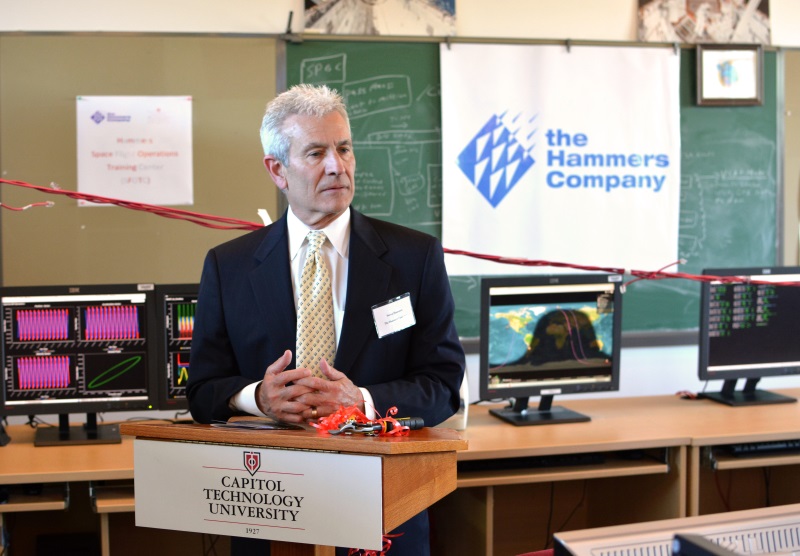
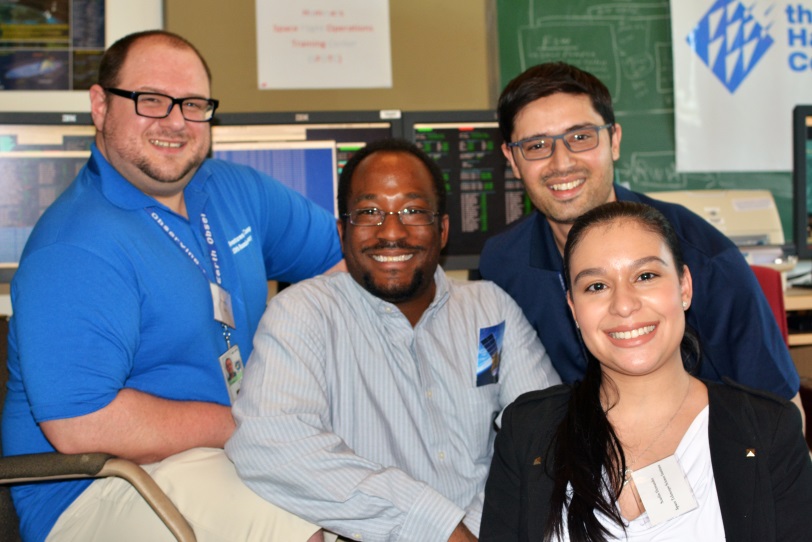
Photos: (1) Steve Hammers, CEO of The Hammers Company, addresses the opening ceremony for the Space Flight Operations Center (SFOTC) at Capitol Technology University. (2) Capitol alumni Ben Holt, Marcel Mabson, Rishabh Maharaja and Scarlin Hernandez were on hand to celebrate the launch of the new SFOTC.
Link: https://captechu.edu/node/2287

 Formerly
chief academic officer and professor at Embry-Riddle University -
Worldwide, Dr. Sims has built significant experience in higher education
over the course of his distinguished career, including as Professor,
Dean, Department Chair, Chief Operating Officer, and Chancellor.